


|

Semiquantitative visualization of glutamate transporter distribution around two different types of synapses
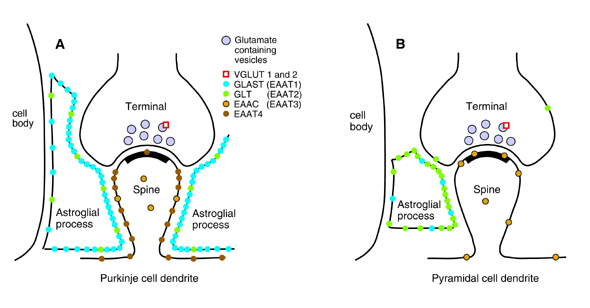
The three different glutamate transporters (EAAT1-3) are found in the
hippocampus, while four types (EAAT1-4) are found in the cerebellum (for
more information see: Lehre
and Danbolt, 1998; Danbolt,
2001). The quantitatively and functionally predominant glutamate transporter
subtype is EAAT2 (also called GLT) which was the one isolated based on
functional reconstitution of transport activity (Danbolt
et al., 1990). This transporter is present in brain tissue at high
concentrations (Lehre and Danbolt, 1998). The highest concentrations are
found in the hippocampus and neocortex. Almost all the protein is present
in astroglial cells in the mature and normal brain and spinal cord, but
a few percent is expressed in terminals. EAAT2 is expressed in neurons
during development and in retinal neurons also in the adult.
EAAT1 (GLAST) is exclusively glial, also during development, and is the
major glutamate transporter in the cerebellum and in the retina.
EAAT3 (EAAC) is expressed at far lower concentrations. It is present in
neurons throughout the nervous system; their cell bodies and dendrites,
but not in the axons and terminals.
EAAT4 is virtually only expressed in the cerebellar Purkinje cells, and
EAAT5 is a retinal protein.
[ back ]